Company News
Blue-White® Partner Mullarkey Associates Hosts Mid-Year Sales Training on Aquatics Solutions
Blue-White® partner Mullarkey Associates recently hosted its mid-year internal sales meeting, featuring

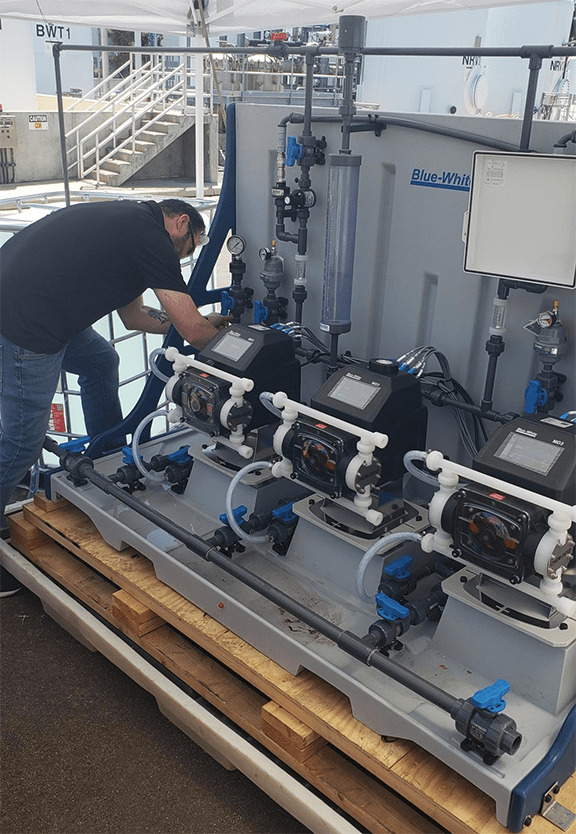
Whenever chemical dosing is used for the treatment of municipal drinking water and wastewater, or industrial process water and effluent, the expectation is that the chemical metering pump will be accurate and its measurements repeatable. However, even the most advanced pump should be calibrated at the time it is installed in order to ensure it produces the flow rates required for the process. Calibration is essential in maintaining process efficiency, ensuring safety, and for compliance with regulatory standards.
It is important that operators understand when and how to calibrate a chemical dosing pump.
Calibrating chemical metering pumps ensures that they deliver the precise amount of fluid required for a specific process. This is particularly important in public water and wastewater treatment where incorrect chemical dosages may lead to ineffective treatment, inadequate disinfection, or other dangerous conditions.
Additional critical reasons to ensure pumps are calibrated include:
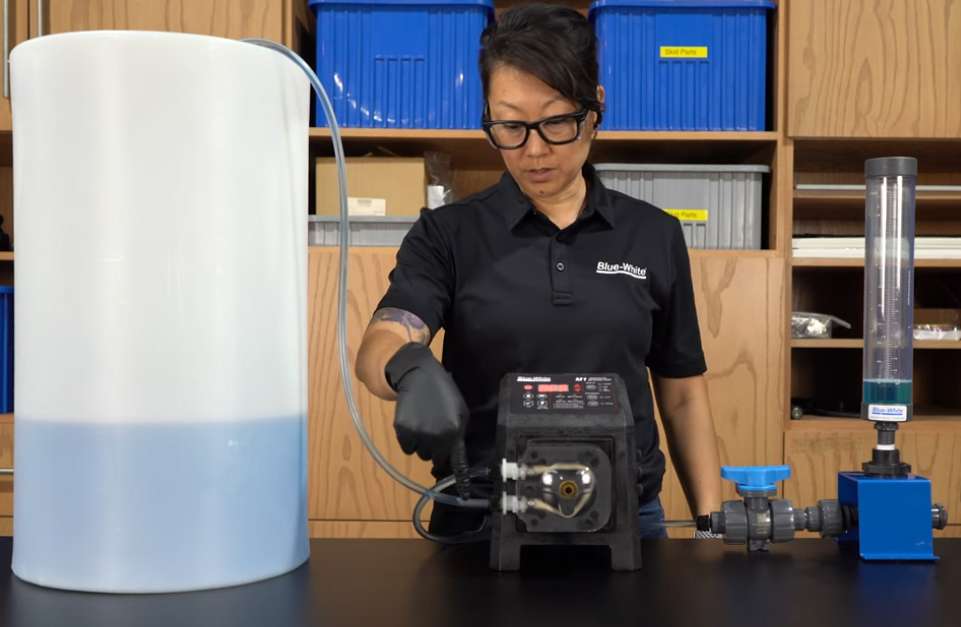
Process control. Proper calibration is essential to process control, especially when feedback from sensors, analyzers, or other measurements/samples is not received in real time. When multiple pumps are used together in a process it’s important that they all be in sync. When a change is made to a system such as piping changes, modification of flow demands, pressure variations, change of chemical being dosed, operators must be confident that the new dosing level is accurate.
Risk reduction. A properly calibrated chemical metering pump also helps reduce the risk of overdosing. In addition to wasting expensive chemicals, overdosing can create unsafe conditions in the plant, damage equipment, and harm the environment. Compliance risks may also be mitigated, including ISO or similar process requirements, as well as meeting government regulations. Violations of the latter can result in hefty fines and other penalties.
Troubleshooting system issues. Pump and downstream system issues can be more easily resolved by ensuring the pump is performing properly and within parameters set by previous calibrations and documentation.
First and foremost, all pumps should be calibrated upon installation. While most manufacturers pre-calibrate pumps before shipping, those pumps are most likely calibrated with water. Chemicals like sodium hypochlorite, sulfuric acid, coagulants, and others will have very different fluid properties. As such, the metering pump should be calibrated using the chemical it will be dosing.
Calibration should also be performed after every service or repair to ensure tolerances have not changed. In addition, whenever a process requires dosing of viscous chemicals, high or varying suction lift conditions, high or varying pressure, and/or frequent changes in flow rate, the pump should be recalibrated.
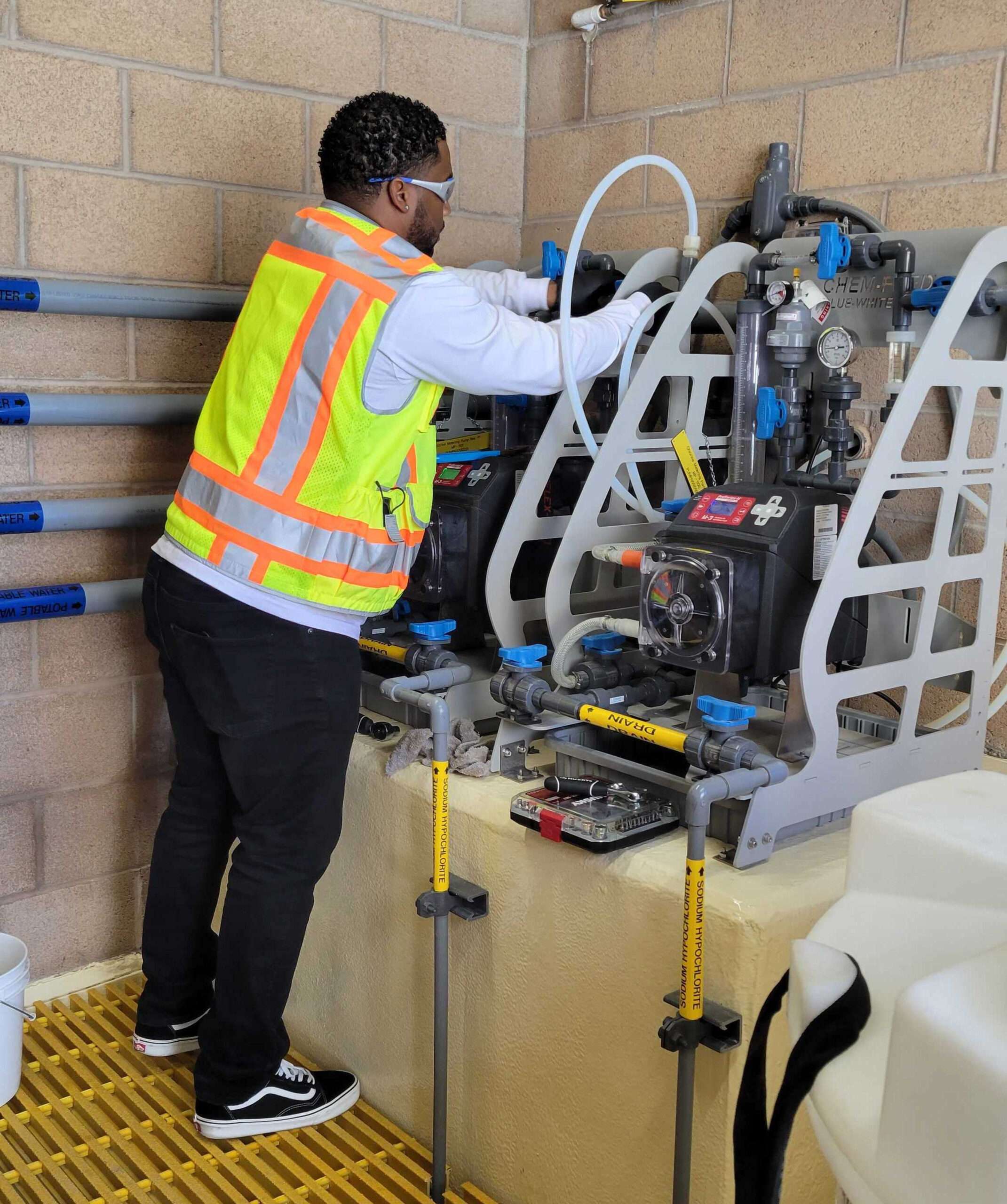
Calibration is typically quick, taking about 10 to 15 minutes per pump. Although chemical metering pumps can be calibrated using flow meters, it is important to remember that even meters must be calibrated and are not always 100% accurate. Therefore, it is strongly recommended that operators perform a physical drawdown (Figure 1). This involves pumping the chemical into a beaker or calibration cylinder over a measured period of time (e.g., using a stopwatch) to physically measure the volume of chemical being delivered. In order to do a drawdown, the appropriate amount of piping is needed near the pump to either draw from or fill the calibration column.
In addition, the pump should be measured at various flow rates. This is because flow rates are not always linear with pump speed or stroke length. Factors like viscosity, suction line length, and discharge line length introduce friction, which can affect flow as pump speed increases. Therefore, the pump should be calibrated at high, low, and typical flow conditions. Once the pump has been calibrated, all the data associated with it should be logged in detail so that it can be used in future calibrations to understand the pump’s overall operational health.
Of course, many factors are involved in the types of processes that require chemical metering. Therefore, operators should always apply a measure of common sense when evaluating calibration results. Do they make sense compared to operator expectations or manufacturer specifications? This common-sense approach helps in identifying discrepancies and aids in troubleshooting your entire system.
Calibration is a fundamental requirement for effective and safe operation of chemical metering pumps in any application. Initial and ongoing calibration ensures that chemical dosing is consistently accurate, preventing costly errors, environmental harm, and noncompliance. A proactive and diligent approach to calibration is an investment in the reliability and longevity of the chemical metering system.
Written by:
Blue-White® Industries
714-893-8529
Blue-White® partner Mullarkey Associates recently hosted its mid-year internal sales meeting, featuring

Blue-White® VP of Sales Danny Sanders has been on the move! Among

Blue-White® VP of Sales, Danny Sanders, visited our valued partner, Eastman Industrial,
Chemical Dosing and Flow Verification for Reliable Water Sanitation using a flow meter, pressure gauge, and skid installation for compliance in Utah